
 DevPixel Engineering
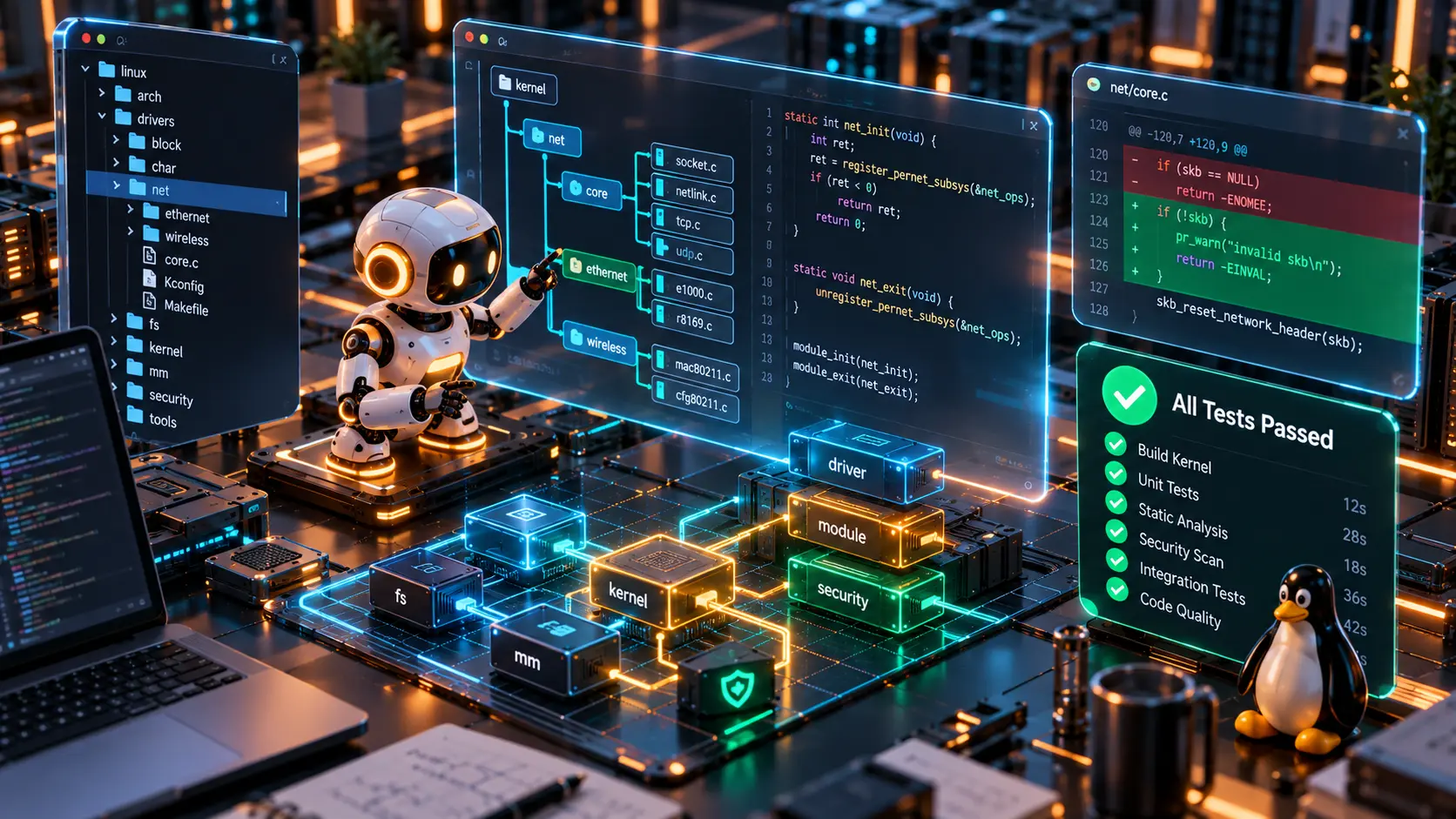
Within the systems engineering discipline, Linus Torvalds is renowned for rigorous standards and vocal skepticism toward superficial software trends — particularly the reckless generation of AI boilerplate. However, during a recent maintenance cycle on the Linux Kernel’s assoc_array branch, Torvalds openly documented his hands-on experience utilizing modern Large Language Models to assist in code comprehension and legacy refactoring.
This pragmatic experiment did not simply untangle an obscure, pointer-heavy C subsystem authored in 2013; it directly uncovered three silent, long-standing bugs that had evaded static analyzers and manual reviews for over thirteen years.
The highest-leverage application of AI in systems programming is not raw code generation, but AI-assisted code comprehension — breaking down dense functions into readable abstractions, formulating userspace test harnesses, and allowing human engineers to verify empirical behavior.
1. The Complexity of the Kernel assoc_array Subsystem
The assoc_array associative array structure in Linux serves high-performance key-to-data mappings inside system memory, utilizing complex pointer bitmasking and tree rotations. When kernel developer Nils Ollrogge submitted an initial bugfix, reviewing the patch required deep comprehension of decades-old logic.
Rather than spending days untangling the dense C implementation line by line, Torvalds leveraged frontier LLM tooling with disciplined constraints:
- Explain the operational control flow and subtle invariants across each branching path.
- Refactor monolithic multi-hundred-line functions into isolated, descriptively named helpers.
- Construct an independent userspace test harness simulating kernel memory structures to stress-test corner cases.
2. The 3-Phase AI Refactoring Methodology
The workflow demonstrates a disciplined template for systems engineers tackling legacy codebases:
Phase 1: Decomposition Without Algorithmic Drift
The model was instructed strictly to avoid altering core algorithms, focusing solely on variable renaming, helper extraction, and clarifying structural assumptions.
Phase 2: Independent Userspace Test Harness Construction
Once the code was structurally decoupled, Torvalds directed the model to generate a standalone C test harness executing in userspace, subjected to randomized stress testing across millions of permutations.
Phase 3: Exposing 13-Year-Old Silent Defects
The harness not only reproduced the initial reported defect, but successfully triggered three additional structural corruptions present since the subsystem’s introduction in 2013. Torvalds subsequently authored the authoritative kernel patches based on these verified findings.
3. AI as a Modern Compiler-Level Abstraction
This inflection mirrors historical milestones in computing: software engineers once hand-wrote assembly instructions until modern compilers provided safe, high-level abstractions. Similarly, AI models function as intelligent semantic compilers — transforming opaque legacy implementations into verified, maintainable systems under strict human supervision.
Read next: Automating Code Review When AI Writes Over 90% of the Codebase
Conclusion
Linus Torvalds’ adoption underscores a defining reality: artificial intelligence does not replace developer rigor. When applied with discipline to code comprehension and test generation, it acts as an unmatched multiplier for senior engineering talent.
Chưa có bình luận nào. Hãy là người đầu tiên chia sẻ góc nhìn!