
 DevPixel Engineering
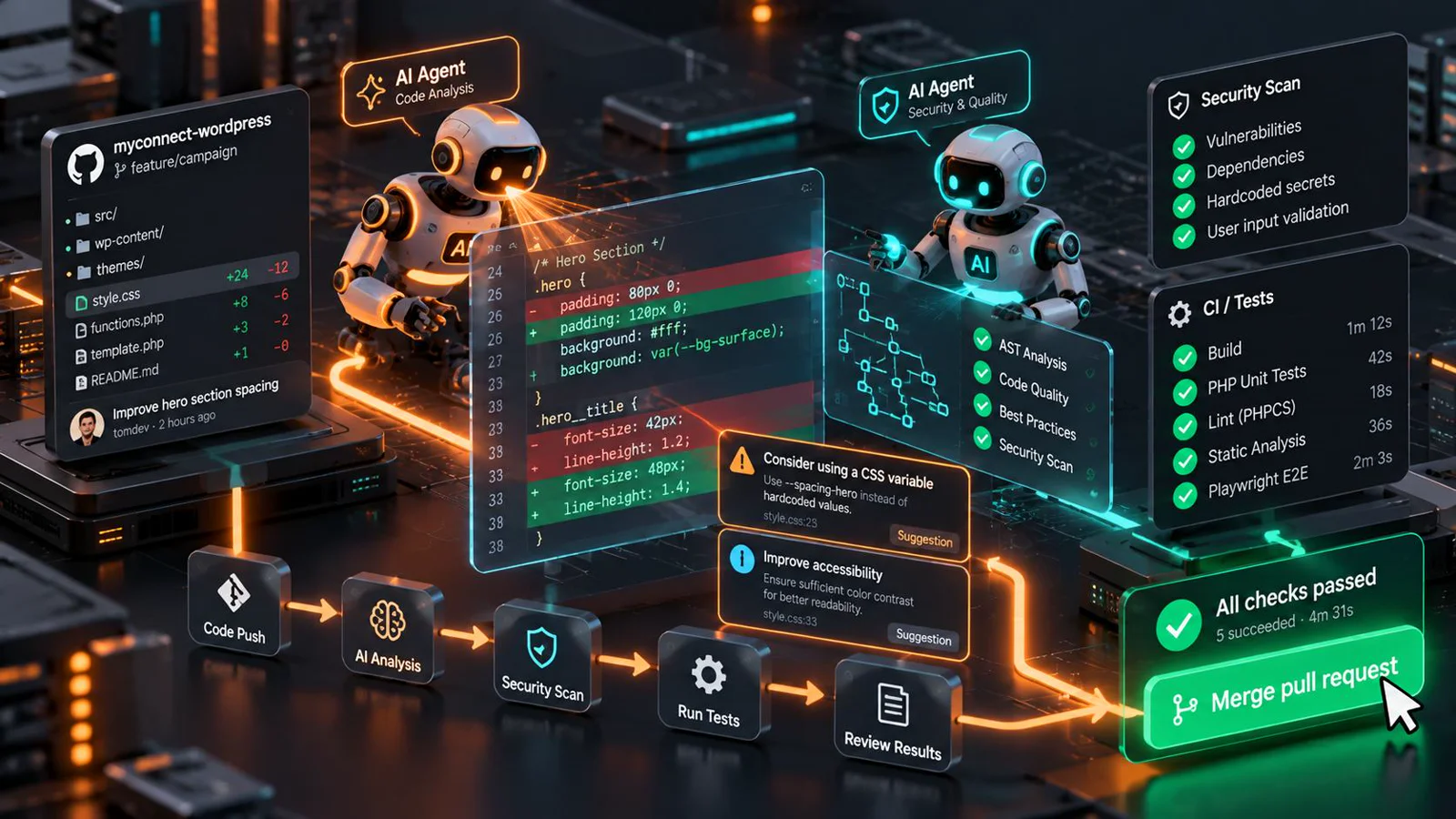
When AI coding agents like Claude Code or Cursor are integrated into active engineering workflows, code generation velocity multiplies exponentially. Production telemetry from Anthropic reveals that daily committed code changes surged from 2,500 commits per day in May to more than 30,000 commits per day by September.
This massive explosion in raw code volume rapidly exposes a critical engineering bottleneck: human review capacity. If organizations maintain traditional code review workflows — opening a pull request (PR) and waiting for a human peer to manually inspect every line — engineering teams become completely paralyzed under review backlogs.
In an era where AI generates over 90% of production code, the bottleneck is no longer how fast we write code. The entire bottleneck has shifted to quality verification, automated safety gates, and risk-calibrated approval pipelines.
1. Redefining the Purpose and Timing of Code Review
Before the rise of autonomous coding agents, the objective of code review was commonly framed around a binary check: “Did a second engineer read through this patch?” This approach turned code review into a gatekeeper waiting at the end of the line, creating PR gridlock and breaking engineer focus.
The team behind Claude Code transformed this mental model through two foundational shifts:
- Reframing the evaluative question: From “Who read this code?” to “What failure modes could this change introduce, and which tool — automated or human — is most effective at catching them?”
- Inverting the verification timeline: Instead of waiting for a pull request to initiate review, inspection happens continuously throughout development, much like an interactive spellchecker in modern document editors. Most syntax errors, broken tests, and interface mismatches are caught and corrected directly inside the agent loop.
2. The 4-Layer Automated Review Architecture
To scale code throughput without degrading production stability, the review pipeline is organized into four resilient defense layers:
Layer 1: Local Pre-Commit Verification with the Second Agent Pattern
Inside the developer’s local workspace, before any commit is finalized, the system executes a Second Agent Pattern (similar to the layered structure detailed in the 4-Agent Pipeline in Claude Code):
- Primary Coding Agent: Implements the feature, refactors logic, and automatically runs local test suites, typechecks, and linters.
- Second Agent (Reviewer with Fresh Context): Once the feature is complete, an isolated agent with a clean context window is spun up exclusively to inspect the git diff. Context isolation completely eliminates confirmation bias — where an agent that wrote the code tends to overlook its own reasoning flaws in prolonged conversation histories.
Layer 2: CI Pipeline Automation & AI Review Bots
When a pull request is submitted to GitHub or GitLab, autonomous review bots powered by large language models (LLMs) trigger immediately:
- Runs concurrent test matrices, static code analysis (SonarQube/Biome), and dependency security scanners (Dependabot).
- AI Review Bots ingest the full PR diff, summarize architectural impact, and comment inline directly on suspect lines.
- Upon identifying unambiguous logical errors, the bot produces executable suggested changes that the author can accept with a single click.
Layer 3: Risk-Based Approval Tiers
Instead of enforcing a rigid, one-size-fits-all policy for every change, risk-based tiers focus human oversight where it matters most:
- Documentation updates and localized UI styling refinements.
- Pure functional logic with 100% automated test coverage.
- Approval mechanism: Author self-approval enabled, routing directly into the Merge Queue.
- Production database schema migrations and indexing changes.
- Authentication flows, permission models, and security boundaries.
- Approval mechanism: Mandatory sign-off from domain architects (Staff/Principal Engineers).
Layer 4: Post-Merge Safety Rails
A resilient development pipeline accepts that no pre-merge review process catches 100% of production defects. Long-term reliability depends equally on deployment infrastructure:
- Feature Flags: Every substantial capability is guarded behind dynamic flags, allowing immediate deactivation without triggering code rollbacks.
- Canary & Gradual Rollouts: Incremental delivery routes traffic to internal dogfooders first, progressing gradually toward full production release.
- Sub-60-Second Rollback Capability: Ensures mean-time-to-recovery (MTTR) remains under one minute from defect detection to stable rollback.
3. Measured Outcomes from Anthropic’s Claude Code Team
By shifting engineers away from manually parsing thousands of AI-generated lines toward designing robust test harnesses and evaluating system architecture, the Claude Code organization recorded dramatic operational gains:
- 2x Pull Request Throughput: Merged PR velocity doubled within a single quarter of operational adoption.
- 40% Reduction in Rollback Rates: Commit reverts declined sharply due to comprehensive automated test gates and the Second Agent pattern.
- Elimination of Review Backlogs: Engineers no longer wait days for small patches to clear review, keeping developer flow states uninterrupted.
4. A 3-Step Implementation Blueprint for Engineering Teams
To successfully integrate this operational model into your organization, proceed through the following phased roadmap:
- Adopt Test-First Agent Workflows: Direct AI coding agents to produce unit and end-to-end integration tests prior to writing feature implementations. Test suites serve as the indispensable anchor that allows AI to iterate autonomously without introducing regressions.
- Institutionalize Local Second-Agent Passes: Establish team-wide slash commands that spin up a clean-context agent to audit git diffs, surface uncovered edge cases, and ensure codebase consistency before opening pull requests.
- Integrate Risk-Calibrated AI Reviewers into CI/CD: Deploy automated LLM-based reviewers across repository pipelines to score pull request risk profiles, allowing senior engineering attention to focus strictly on sensitive architectural domains.
Conclusion
Automating code review does not mean delegating unmonitored authority to artificial intelligence. Instead, it represents an intentional evolution in engineering discipline: leveraging automated machines for what machines execute best, while reserving human cognitive focus for critical system architecture and long-term product decisions.
Chưa có bình luận nào. Hãy là người đầu tiên chia sẻ góc nhìn!