
 DevPixel Engineering
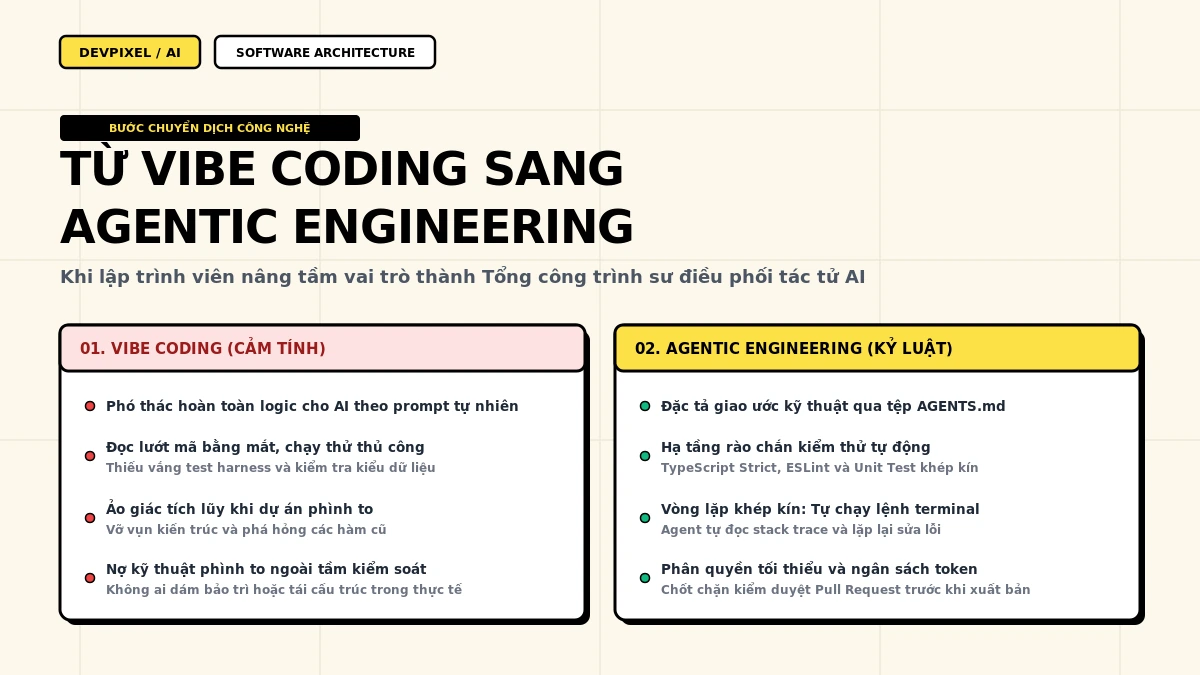
In early 2025, former Tesla and OpenAI AI director Andrej Karpathy coined the phrase Vibe Coding, igniting a viral movement across the global developer community. The philosophy was undeniably seductive: disregard syntax, ignore complex type declarations, immerse yourself in conceptual exploration, and let large language models generate the code.
However, as initial euphoria settles and software projects transition into production environments, teams confront the harsh limitations of pure intuition. A profound architectural paradigm shift is now underway across enterprise software engineering: moving from exploratory Vibe Coding toward systematic Agentic Engineering.
If Vibe Coding is the outsourcing of code generation to unconstrained intuition, Agentic Engineering is the discipline of constructing automated harnesses, technical guardrails, and deterministic feedback loops that allow autonomous coding agents to perform with production-grade precision.
1. The Hard Boundaries of Intuitive Vibe Coding
Vibe coding works remarkably well when prototyping a throwaway proof-of-concept, a single-file script, or an experimental landing page in an afternoon. But the moment an application spans dozens of interdependent modules and serves production users, developers hit three insurmountable barriers:
- Compounding Hallucinations: As context windows fill up, models invent non-existent APIs, misremember function signatures, and generate phantom dependencies, triggering cascading runtime regressions.
- Architectural Drift: The model solves immediate conversational prompts while unknowingly dismantling structural assumptions established in earlier commits due to lack of longitudinal holistic awareness.
- Paralyzing Technical Debt: Codebases mushroom rapidly without unit test suites, type contracts, or architectural specifications, turning ongoing maintenance into a high-friction nightmare.
Vibe coding gives developers euphoria across the first 100 lines of code, but degenerates into a debugging nightmare at line 10,000 without rigorous technical discipline.
2. Defining Agentic Engineering
Agentic Engineering does not mean abandoning AI assistance to revert to manual keyboarding. Rather, it elevates the software engineer from an interactive prompter into a Chief Systems Architect who designs environments, enforces constraints, and orchestrates autonomous agent loops — mirroring patterns found in Anthropic’s Virtual Collaborator Architecture.
Instead of manually copying diffs out of chat dialogues, the engineer equips autonomous agents with full terminal access, execution sandboxes, live diagnostic telemetry, and autonomous repair capabilities until every verification suite passes cleanly.
3. The Four Foundational Pillars of Agentic Engineering
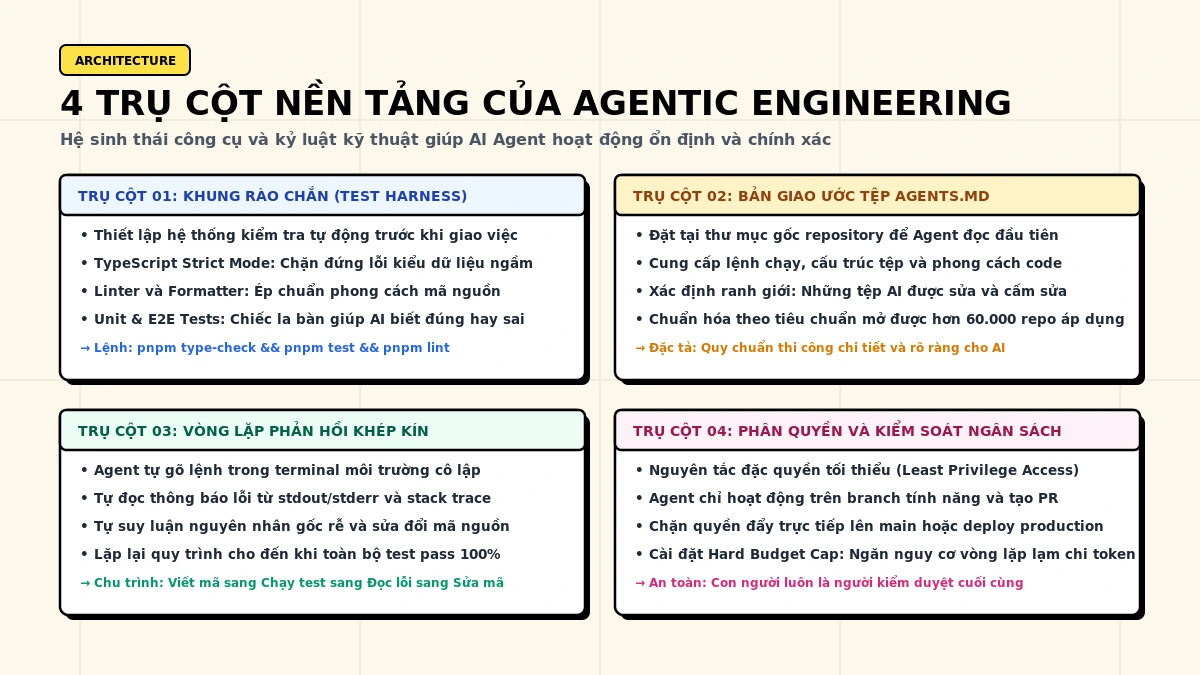
Establishing an effective Agentic Engineering workflow requires four cohesive infrastructure pillars:
- Deterministic Test Harnesses: The repository must enforce automated linter rules, strict static type checking (e.g., TypeScript strict mode), and automated unit test suites. These tests serve as deterministic sensors guiding the agent.
- Contextual Specifications via AGENTS.md: Just as humans reference README.md files, autonomous agents require structured contracts in an
AGENTS.mdfile at repository root. This contract defines build scripts, style invariants, and explicit boundaries — seamlessly complementing UI rules like OpenDesign’s DESIGN.md specifications. - Closed-Loop Execution Telemetry: Autonomous agents must execute shell commands, parse stdout and stderr streams, interpret runtime stack traces, and iteratively modify source files until zero errors remain.
- Least-Privilege Scoping and Budget Safeguards: Agents operate within constrained feature branches and submit pull requests. Destructive operations (direct push to main or production deploy) remain strictly gated, fortified by supply-chain agent security and Hard Budget Caps.
4. Standardizing Repositories with AGENTS.md Specifications
The foundational step toward operational Agentic Engineering is establishing a root AGENTS.md specification. Below is a production-ready contract designed for modern Next.js and TypeScript repositories:
5. Paradigm Comparison: Vibe Coder vs. Agentic Engineer
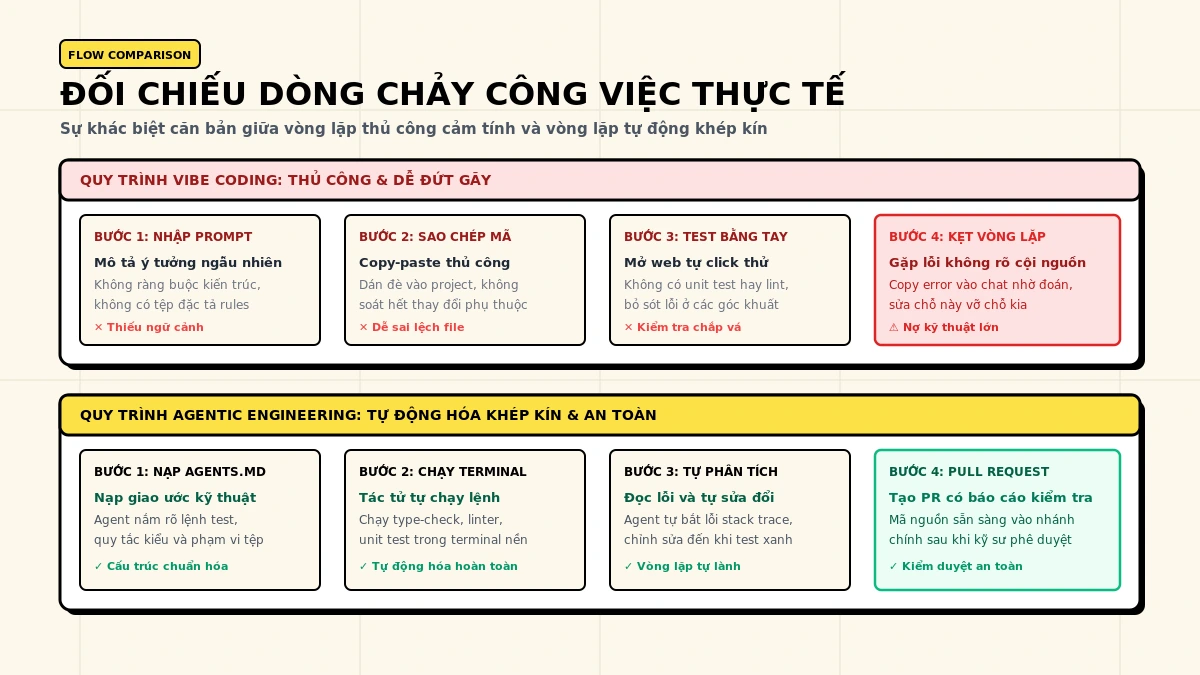
The operational distinctions separating both paradigms are evident across daily engineering workflows:
- Interaction Modality: Vibe coders engage in unstructured conversational chat; agentic engineers issue declarative briefs backed by contracts, CLI harnesses, and automated testing suites.
- Verification Surface: Vibe coders manually eyeball code and click UI elements; agentic engineers rely on automated CI/CD pipelines and programmatic telemetry.
- Failure Recovery: Vibe coders copy-paste error logs back into chat prompts; agentic agents parse stack traces directly in terminals and iteratively resolve regressions.
- Maintainability & Longevity: Vibe code rapidly degrades into fragile spaghetti; agentic architectures remain modular, auditable, and production-ready.
6. Conclusion
Vibe coding democratized early access to software creation. However, turning conceptual ideas into resilient, enterprise-grade software requires transitioning into Agentic Engineering.
The defining skill of the next software decade is not memorizing syntax or library methods, but mastering systems architecture, automated verification pipelines, and multi-agent orchestration.
Chưa có bình luận nào. Hãy là người đầu tiên chia sẻ góc nhìn!