
 DevPixel Engineering

.single-blog-content .code-window-block {
border: 2px solid #000000 !important;
border-radius: 10px !important;
box-shadow: 3px 3px 0 #000000 !important;
overflow: hidden !important;
margin: 32px 0 !important;
background: #111215 !important;
}
.single-blog-content .code-window-header {
display: flex !important;
flex-direction: row !important;
align-items: center !important;
justify-content: space-between !important;
height: 42px !important;
min-height: 42px !important;
max-height: 42px !important;
padding: 0 16px !important;
background: #1a1c22 !important;
border-bottom: 2px solid #000000 !important;
box-sizing: border-box !important;
gap: 10px !important;
}
.single-blog-content .code-window-header p {
display: contents !important;
}
.single-blog-content .code-window-header br {
display: none !important;
}
.single-blog-content .code-window-header .window-dots {
display: inline-flex !important;
align-items: center !important;
gap: 6px !important;
flex-shrink: 0 !important;
}
.single-blog-content .code-window-header .window-dot {
display: inline-block !important;
width: 10px !important;
height: 10px !important;
border-radius: 50% !important;
border: 1px solid rgba(0, 0, 0, 0.4) !important;
flex-shrink: 0 !important;
}
.single-blog-content .code-window-header .dot-red { background: #ff5f56 !important; }
.single-blog-content .code-window-header .dot-yellow { background: #ffbd2e !important; }
.single-blog-content .code-window-header .dot-green { background: #27c93f !important; }
.single-blog-content .code-file-name {
color: #e2e8f0 !important;
font-family: “IBM Plex Mono”, monospace !important;
font-size: 11.5px !important;
font-weight: 700 !important;
letter-spacing: 0.5px !important;
text-transform: uppercase !important;
margin-left: 8px !important;
margin-right: auto !important;
white-space: nowrap !important;
overflow: hidden !important;
text-overflow: ellipsis !important;
min-width: 0 !important;
flex: 1 1 auto !important;
}
.single-blog-content .code-copy-btn {
display: inline-flex !important;
align-items: center !important;
gap: 6px !important;
height: 26px !important;
padding: 0 12px !important;
font-size: 11px !important;
font-weight: 800 !important;
font-family: “IBM Plex Mono”, monospace !important;
color: #000000 !important;
background: #fde047 !important;
border: 1.5px solid #000000 !important;
border-radius: 6px !important;
box-shadow: 2px 2px 0 #000000 !important;
cursor: pointer !important;
user-select: none !important;
line-height: 1 !important;
transition: transform 0.1s ease, box-shadow 0.1s ease, background 0.15s ease !important;
margin-left: auto !important;
flex-shrink: 0 !important;
white-space: nowrap !important;
}
.single-blog-content .code-copy-btn * {
color: #000000 !important;
stroke: #000000 !important;
}
.single-blog-content .code-copy-btn:hover {
transform: translate(-1px, -1px) !important;
box-shadow: 3px 3px 0 #000000 !important;
background: #fef08a !important;
}
.single-blog-content .code-copy-btn:active {
transform: translate(1px, 1px) !important;
box-shadow: 1px 1px 0 #000000 !important;
}
.single-blog-content .code-copy-btn.copied {
background: #dcfce7 !important;
color: #15803d !important;
}
.single-blog-content .code-copy-btn.copied * {
color: #15803d !important;
stroke: #15803d !important;
}
.single-blog-content .code-window-block pre {
margin: 0 !important;
padding: 18px 20px !important;
background: #111215 !important;
color: #f3f4f6 !important;
font-family: “IBM Plex Mono”, monospace !important;
font-size: 13.5px !important;
line-height: 1.7 !important;
overflow-x: auto !important;
border: none !important;
box-shadow: none !important;
}
/* ── MOBILE OPTIMIZATIONS (<= 640px) ── */
@media (max-width: 640px) {
.single-blog-content .code-window-block {
margin: 22px 0 !important;
border-radius: 8px !important;
box-shadow: 2.5px 2.5px 0 #000000 !important;
}
.single-blog-content .code-window-header {
height: 38px !important;
min-height: 38px !important;
max-height: 38px !important;
padding: 0 10px !important;
gap: 8px !important;
}
.single-blog-content .code-window-header .window-dots {
gap: 5px !important;
flex-shrink: 0 !important;
}
.single-blog-content .code-window-header .window-dot {
width: 8px !important;
height: 8px !important;
flex-shrink: 0 !important;
}
.single-blog-content .code-file-name {
font-size: 10px !important;
margin-left: 4px !important;
letter-spacing: 0.3px !important;
white-space: nowrap !important;
overflow: hidden !important;
text-overflow: ellipsis !important;
min-width: 0 !important;
flex: 1 1 auto !important;
}
.single-blog-content .code-copy-btn {
height: 24px !important;
padding: 0 8px !important;
font-size: 10.5px !important;
gap: 4px !important;
border-radius: 5px !important;
box-shadow: 1.5px 1.5px 0 #000000 !important;
flex-shrink: 0 !important;
}
.single-blog-content .code-copy-btn svg {
width: 11px !important;
height: 11px !important;
}
.single-blog-content .code-window-block pre {
padding: 14px 14px !important;
font-size: 12px !important;
line-height: 1.6 !important;
}
}
Quick Summary (TL;DR): When applying large AI models like Claude to complex software projects, using a single chat session (Monolithic Context) often wastes millions of input tokens and easily leads to hallucinations. Ruflo (formerly Claude Flow) fundamentally solves this problem by decomposing projects into a Multi-Agent Swarm ecosystem, intelligently tiering models combined with Prompt Caching, helping reduce API costs by up to 75% while improving code quality.
Most developers using AI typically start by opening a chat session, copying the entire codebase, sending error logs, and asking the AI to write new features, write tests, and self-debug all at once. While this approach might work fine for short scripts, it quickly runs into three major roadblocks in real-world projects:
- Exploding Token Costs: Each interaction requires resending the entire history of tens of thousands of tokens, causing API bills to skyrocket exponentially.
- Degraded Memory and Focus: As the context window gets cluttered with miscellaneous information, the AI begins ignoring critical constraints and generating buggy code.
- Operational Bottlenecks: A sequential processing pipeline cannot leverage the power of executing multiple stages—such as writing code and generating unit tests—in parallel.
Ruflo was created to completely restructure this mindset. By leveraging a multi-agent swarm architecture, Ruflo assigns tasks to independent agents while optimizing data flow to minimize operational costs to the absolute minimum.
1. Four Mechanisms That Help Ruflo Save 75% on API Costs
The 75% figure is not theoretical hype, but stems from 4 deeply optimized engineering design principles:
Flexible Model Tiering
In a software workflow, not every step demands the high-level reasoning power of expensive models like Claude 3.5 Sonnet or Opus. Ruflo intelligently routes tasks by tier:
- Orchestrator and Architect Agent: Uses Claude 3.5 Sonnet to design the overall architecture, define API schemas, and plan module breakdown.
- Coder Agent: Uses Sonnet for critical algorithms, or switches to mid-tier models for basic logic files.
- Tester and Doc Agent: Shifts to Claude 3.5 Haiku or models that are many times lighter to generate unit tests, mock data, and write documentation. The token cost of Haiku is only a fraction of Sonnet’s.
Context Isolation and Compression
Instead of forcing a single agent to read all 50 files in the source code, Ruflo uses an AST Dependency Graph mechanism. When the Coder Agent needs to rewrite a function in the authentication module, it only receives that specific file along with the interfaces of related services (about 2,000 to 4,000 tokens instead of 100,000 tokens). A concise context not only reduces costs but also helps the AI stay highly focused and avoid distractions.
Fully Leveraging Anthropic Prompt Caching
Ruflo is architected for seamless compatibility with Anthropic’s Prompt Caching feature. Static components such as each Agent’s System Prompt, the Tools/MCP list, and the project directory structure are cached on Anthropic’s servers. Every subsequent call receives up to a 90% discount on this entire cached portion of the prompt.
Local Gatekeeping
Ruflo establishes an immutable principle: never call an AI to do what local tools can do for free. When the Coder Agent finishes a file, the system automatically runs the linter (ESLint, Prettier, tsc) and the terminal test suite first. If there are syntax errors, it merely sends a brief notification back to the Coder Agent for immediate fixing, strictly avoiding triggering the expensive Reviewer Agent before the code passes the basic checks.
2. Ruflo’s Three Core Architectural Layers
The Ruflo ecosystem is organized into three distinct tiers, ensuring absolute independence and safety between processes:
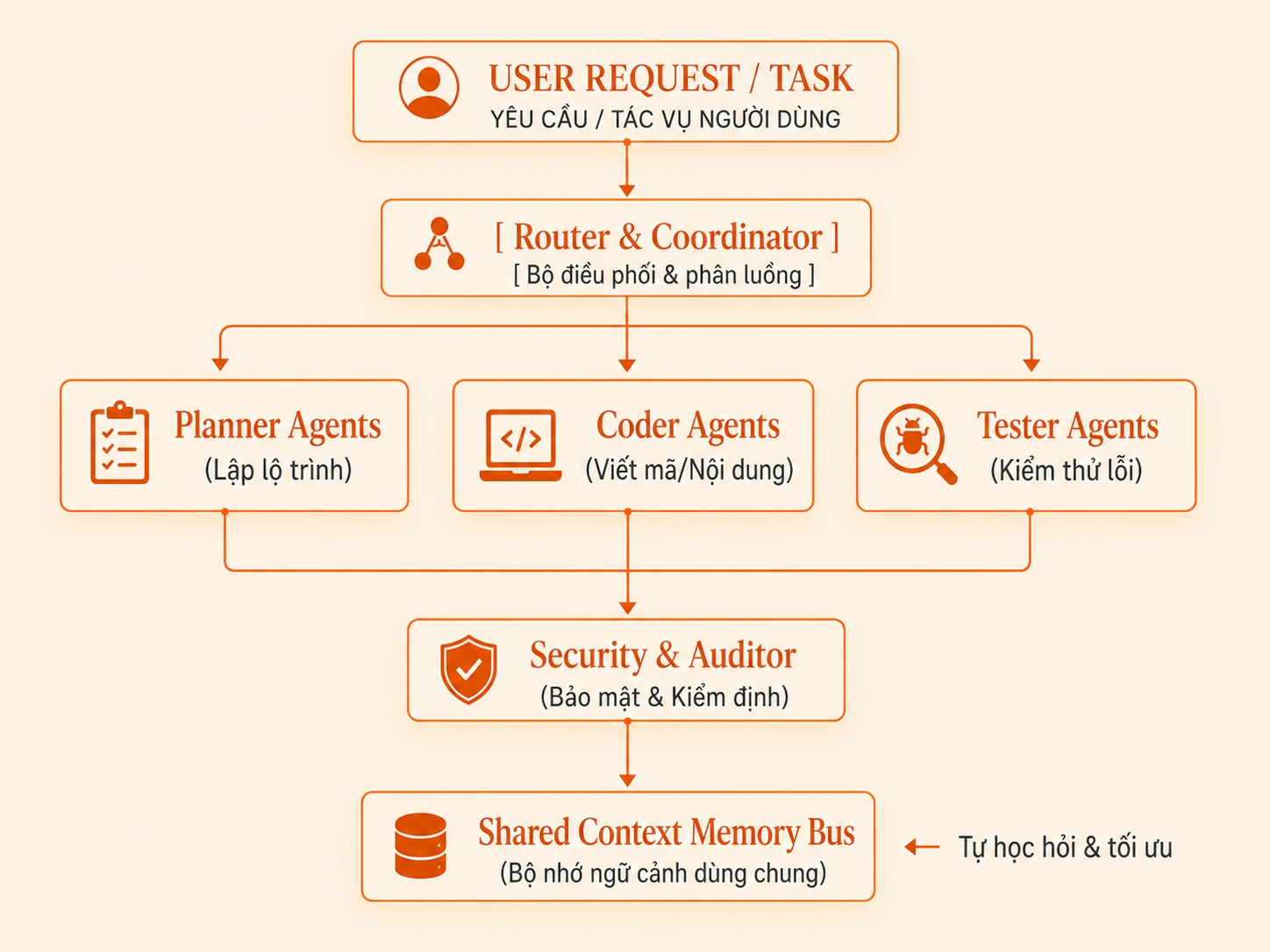
1. Orchestration Layer (Orchestrator & DAG Scheduler)
Serving as the central brain of Ruflo, when receiving a complex command from a developer, the Orchestrator does not start coding immediately. Instead, it decomposes the problem into a Directed Acyclic Graph (DAG). This graph clearly defines what needs to be done first (designing database schemas, interfaces), what can run in parallel (writing API endpoints and mocking UIs), and what should be done last (e2e testing and merging).
2. Specialized Worker Swarm
Each Agent in the swarm is a completely isolated entity with a specialized role:
- Architect / Planner Agent: Specializes in reviewing the repo structure, writing technical specifications, and finalizing communication contracts.
- Coder Agent: Focuses exclusively on writing code for a well-defined, narrow scope while strictly adhering to the project’s coding standards.
- Tester Agent: Examines new code and generates unit test and integration test suites to challenge the source code.
- Security & Reviewer Agent: Checks for common security vulnerabilities (SQL Injection, XSS, secret leaks, missing authentication) before allowing commits to be created.
3. Shared Context & Memory Bus
Instead of agents having to send the entire conversation to each other, Ruflo uses a local Context Bus (based on SQLite and Git diff files). When the Coder Agent finishes its work, it only pushes a summary of changes along with a patch file to the bus. The Tester Agent reads that patch file directly from the hard drive to write tests, keeping everyone’s context window clean and maximally cost-efficient.
3. 4-Step Operational Workflow in a Real Project
Imagine you want to build a Google OAuth2 login feature and send a welcome email for a Next.js project. Ruflo’s operational workflow will automatically unfold as follows:
- Step 1: Architecture Planning (Architect Agent): Scans the entire repo structure, detecting that the project is using Next.js App Router and Prisma ORM. This agent generates a plan consisting of 3 tasks: (1) Update the User model in Prisma, (2) Create the route handler
/api/auth/google/callback, (3) Integrate the Resend service to send emails. - Step 2: Parallel Coding (Coder Swarm): Two Coder Agents are spawned simultaneously. Agent A handles the backend auth logic, while Agent B takes care of the email-sending module based on the finalized interface. Both finish concurrently without having to wait for each other.
- Step 3: Local Testing (Tester Agent): Writes test cases mocking Google OAuth tokens, testing success scenarios, network errors, and duplicate emails. Runs Vitest locally to ensure a 100% pass rate.
- Step 4: Security Review & PR Creation (Reviewer Agent): Scans all file diffs, checking whether the Client Secret is hardcoded and verifying that session cookies have the required
HttpOnly; Secure; SameSite=Laxflags. Once all standards are met, it automatically creates a commit and opens a Pull Request with a detailed summary.
4. Installation and Configuration Guide for Ruflo
You can deploy Ruflo on your personal machine or a CI/CD server via the following simple steps:
Install CLI via npm
npm install -g rufloInitialize Configuration in the Project
Navigate to your project directory and run the command to initialize the configuration file:
ruflo initA ruflo.config.json file will be generated. Below is a standard configuration optimized for cost and performance:
{
  "version": "1.0",
  "orchestrator": {
    "model": "claude-3-5-sonnet-latest",
    "max_concurrent_agents": 3,
    "prompt_caching": true
  },
  "roles": {
    "planner": {
      "model": "claude-3-5-sonnet-latest",
      "temperature": 0.2
    },
    "coder": {
      "model": "claude-3-5-sonnet-latest",
      "temperature": 0.3
    },
    "tester": {
      "model": "claude-3-5-haiku-latest",
      "temperature": 0.1
    },
    "reviewer": {
      "model": "claude-3-5-sonnet-latest",
      "temperature": 0.2
    }
  },
  "guardrails": {
    "run_local_lint": true,
    "run_local_test": true,
    "max_iterations_per_task": 5
  }
}
Set Up API Key and Run the Test
Export the environment variable containing your Anthropic API Key:
export ANTHROPIC_API_KEY="sk-ant-api..."Now, assign the task to the entire swarm of agents for automated execution:
ruflo run --task "Bổ sung rate limiting cho toàn bộ API routes dùng Redis và viết unit test kiểm tra"You will see the CLI display each Agent’s progress in real time, along with the exact token count and cost saved at each step.
5. Comparison: Single Chat vs. Ruflo Multi-Agent Swarm
The fundamental operational differences between the traditional approach and the Ruflo architecture:
- Context Window Management: Single chat sends the entire cumulative history with each turn, easily overflowing the context window and forgetting earlier instructions. Ruflo isolates context per specialized agent, with each session consuming only 2,000 to 5,000 tokens.
- Token Costs: Single chat uses a single expensive model for everything. Ruflo combines model tiering (Sonnet for planning, Haiku for testing) and Prompt Caching, directly reducing API billing costs by 75%.
- Speed and Performance: Single chat must execute sequentially, one step at a time. Ruflo activates worker agents to run in parallel across independent branches.
- Quality and Testing: Single chat often skips or only writes superficial tests due to running out of context. Ruflo employs dedicated Tester and Reviewer Agents that require code to pass real-world tests before it is finalized.
- Risk of Generating Buggy Code (Hallucinations): Single chat exhibits a high hallucination rate as the project grows. Ruflo prevents this using local validation gates (linters, compilers) directly on the machine before passing results to the next step.
6. Frequently Asked Questions (FAQ)
1. Is Ruflo an official Anthropic product?
No, Ruflo is an open-source project developed by an engineering community, leveraging Anthropic’s latest APIs and optimization mechanisms (such as Prompt Caching and Tool Use) to orchestrate multi-agent systems.
2. Does Ruflo completely replace Claude Code?
Ruflo is not intended to replace it, but rather acts as an orchestration layer on top. You can combine both: use Claude Code for day-to-day, direct interactive tasks, and use Ruflo when you need to run large automated pipelines that require multiple agents coordinating in parallel.
3. Does the 75% API cost reduction come with a decrease in code quality?
Not only does it not decrease, but the code quality is actually higher. Because each agent is isolated within a specialized context, it avoids information overload; at the same time, every line of code must pass both the local linter and the Reviewer Agent before being merged.
4. Do I need a powerful computer to run Ruflo?
No. Ruflo is just a lightweight Node.js program running in the terminal to route APIs and call command-line tools. All heavy AI processing takes place on Anthropic’s cloud servers.
5. How to prevent Agents from falling into infinite loops when fixing bugs?
Ruflo includes the max_iterations_per_task parameter in the configuration file (defaults to 5 attempts). If the tests still do not pass after 5 attempts, the process will stop, report the root cause, and ask for direct instructions from the developer instead of continuing to make API calls automatically.
6. Does Ruflo support AI models other than Claude?
Ruflo is designed primarily for the Anthropic ecosystem to take full advantage of its superior Prompt Caching and Tool Use mechanisms. However, thanks to its adapter architecture, you can still plug in OpenAI GPT-4o or DeepSeek for Worker Agents if desired.
7. Is my source code data secure when using Ruflo?
Ruflo is entirely client-side code running on your machine. The project has no intermediary servers storing code. All requests are sent directly from your machine to the official Anthropic API via an encrypted HTTPS connection.
8. Who is Ruflo best suited for?
Ruflo is especially suitable for two groups: (1) Independent software engineers (Solopreneurs) looking to multiply their productivity as if having an entire dev team at their service, and (2) Lean tech teams aiming to automate CI/CD pipelines, refactoring, and test writing without burning through their monthly API budget.
7. Conclusion and Implementation Recommendations
The era of chatting with AI through a single input box is giving way to Multi-Agent Swarms architectures. Ruflo not only delivers cost-reduction benefits, but more importantly, it standardizes your entire software development workflow into clear, tested, and fully secure stages.
If you are building serious software projects with Claude, try transitioning a small module to run on a Ruflo Swarm today to experience the distinct difference in both productivity and cost.
Chưa có bình luận nào. Hãy là người đầu tiên chia sẻ góc nhìn!