
 DevPixel Engineering
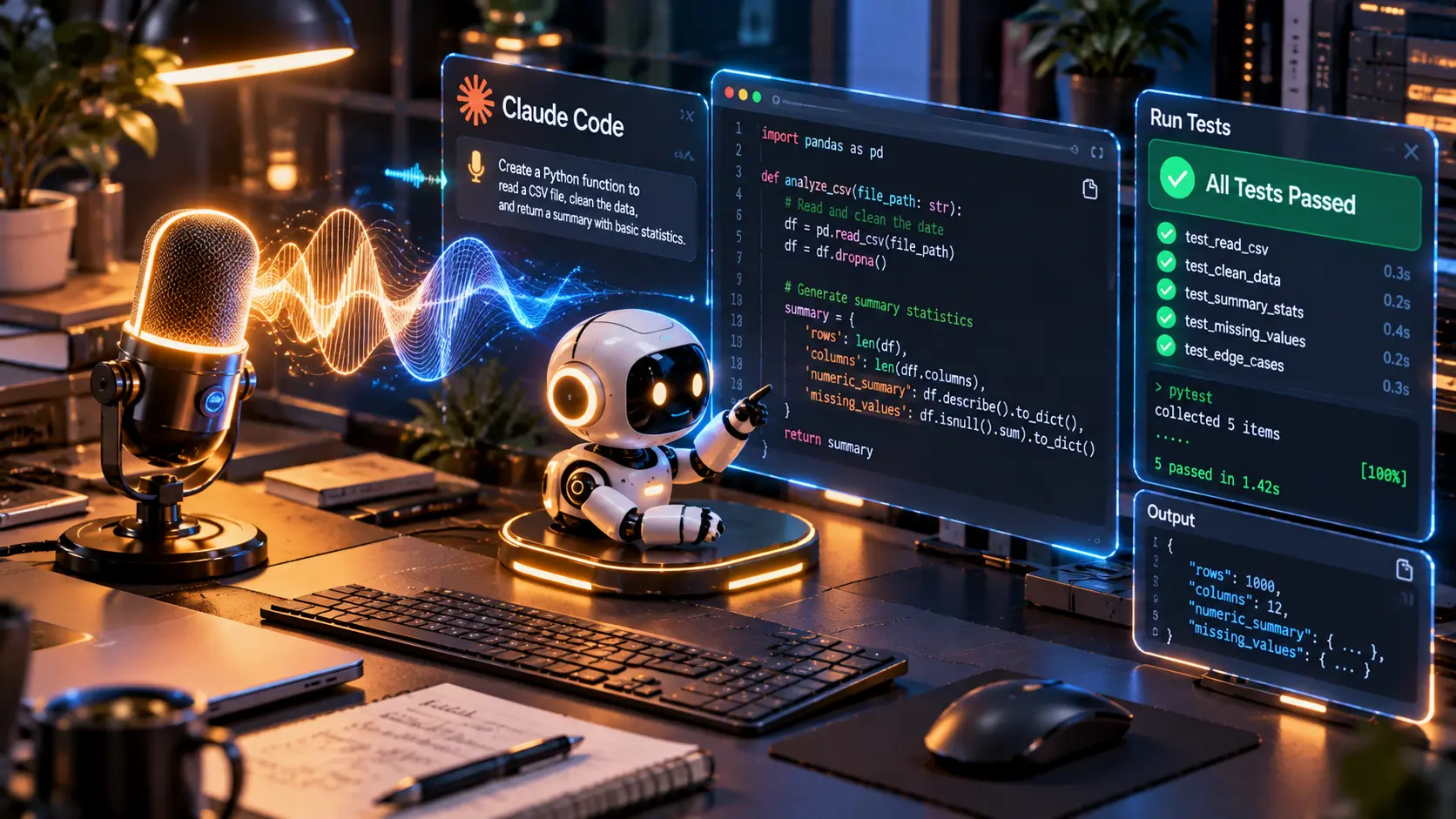
For decades, physical keyboards and mice have remained the solitary interface through which developers translate cognitive logic into executable source code. However, with the rapid maturation of streaming speech-to-text engines (such as Whisper and Deepgram) integrated with autonomous coding agents (like Claude Code), an entirely distinct software development discipline is taking hold: Voice-Driven Coding.
Simon Willison recently documented authoring an entire newsletter management service for his weblog exclusively via spoken conversation with his laptop microphone while cooking dinner. No longer a gimmick, voice-driven development provides authentic multitasking leverage for software engineers.
Voice-driven programming is not phonetic syntax dictation. It operates at an architectural abstraction level: articulating intent, establishing test parameters, and approving candidate diffs surfaced by autonomous agents.
1. Architecture of a Production Voice-Driven Coding Pipeline
A resilient voice development environment synchronizes three core subsystems:
- Streaming Audio & VAD Pipeline: Transcribes spoken audio with sub-300ms latency while supporting hardware voice activity detection (VAD) for natural interruption handling.
- Semantic Intent Parser: Deconstructs conversational speech into structured commands, identifying files, branch context, and operational parameters.
- Autonomous Execution Agent: Traverses codebases, generates diffs, executes test suites, and communicates outcomes through synthesized concise audio summaries.
2. Best Practices for Voice-Driven Software Engineering
Maximizing productivity through voice commands demands structured conversational discipline:
- Decompose Work into Atomic Units: Rather than issuing sweeping instructions, structure requests incrementally: “Generate the migration schema for users,” followed by “Write edge case unit tests for password hashing,” and “Construct the registration API endpoint.”
- Require Pre-Execution Confirmation: Enforce an interactive handshake where the agent states: “I am about to modify auth.ts and run the test suite; confirm execution.”
- Leverage Text-to-Speech Status Feedback: Employ audio speech synthesis to announce test results (e.g., “All 12 test assertions passed, code coverage stands at 94%”), keeping developers informed without requiring visual focus on terminals.
Read next: Automating Software Workflows with a 4-Agent Pipeline in Claude Code
Conclusion
Voice-driven development not only alleviates ergonomic strain from physical typing, but transforms programming into an expressive, natural architectural dialogue between engineers and intelligent agents.
Chưa có bình luận nào. Hãy là người đầu tiên chia sẻ góc nhìn!